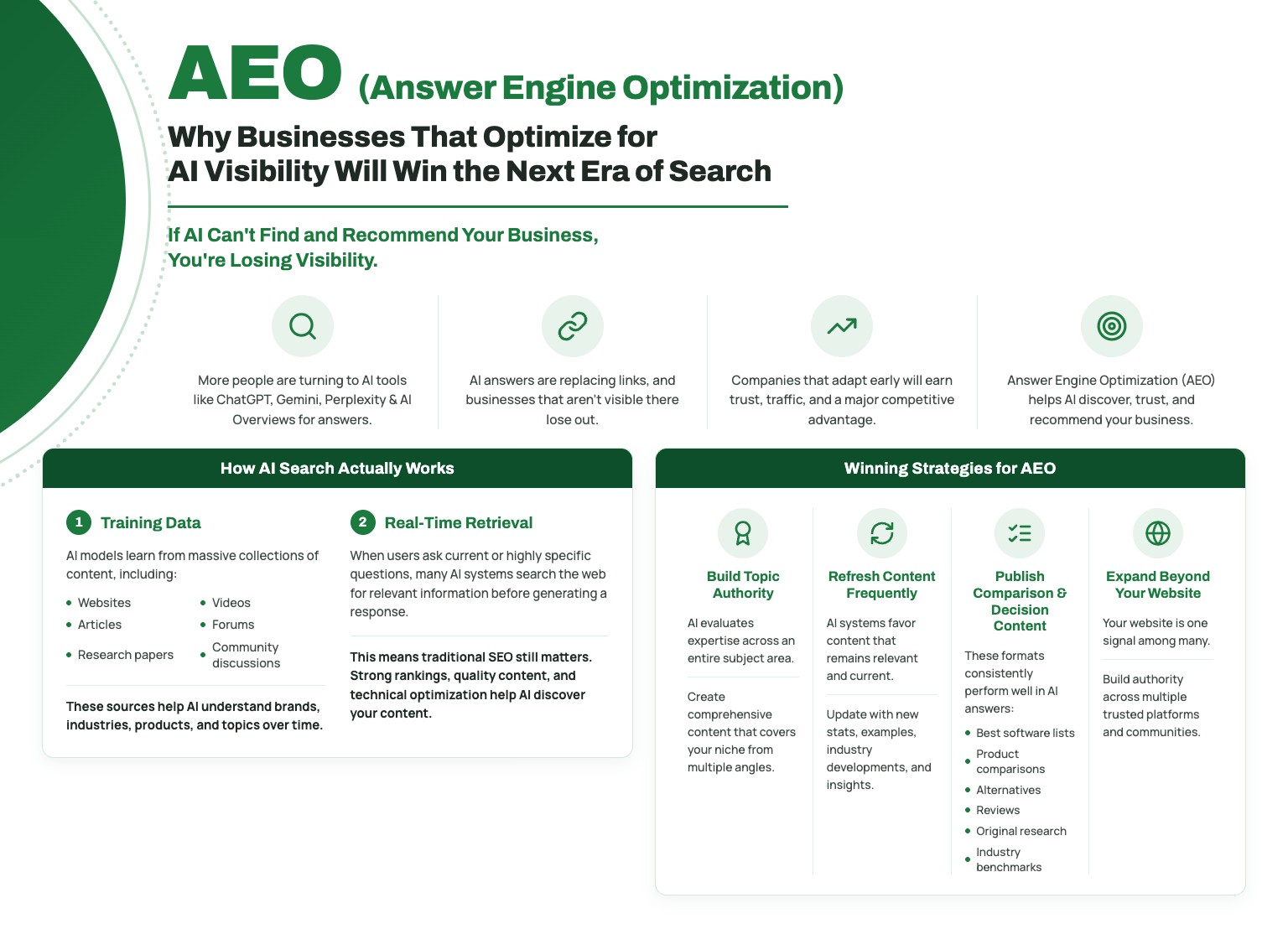
If AI Can't Find and Recommend Your Business, You're Losing Visibility
The future of search isn't just about ranking on Google. It's about being recommended by AI.
As more consumers turn to ChatGPT, Google AI Overviews, Gemini, Perplexity, and other AI-powered search tools for answers, businesses face a new challenge: earning visibility inside AI-generated responses.
Companies that adapt early will gain a significant competitive advantage. Those that rely solely on traditional SEO risk becoming increasingly invisible as AI answers replace clicks.
This shift has given rise to a new discipline: Answer Engine Optimization (AEO).
What Is Answer Engine Optimization (AEO)
Answer Engine Optimization is the process of optimizing your content, brand presence, and digital authority so AI systems can discover, understand, trust, and recommend your business when generating answers.
Traditional SEO focuses on rankings.
AEO focuses on recommendations.
The key question is no longer: "Can I rank #1 on Google?" It's becoming: "Will AI mention my business when someone asks for a solution?"
Why AEO Matters Right Now
AI search traffic converts at 14.2%, compared to 2.8% for traditional Google organic search, roughly five times more valuable per session. (Exposure Ninja, March 2026)
🔗 Primary source: https://exposureninja.com/blog/ai-search-statistics/
Search behavior is changing faster than most businesses realize.
AI platforms generated 1.13 billion referral visits in a single month (June 2025) a 357% increase from the same month the year prior. (Similarweb, 2025)
🔗 Primary source: https://www.similarweb.com/blog/insights/ai-news/ai-referral-traffic-winners/
🔗 Also covered by TechCrunch: https://techcrunch.com/2025/07/25/ai-referrals-to-top-websites-were-up-357-year-over-year-in-june-reaching-1-13b/
Users increasingly expect immediate answers instead of pages of search results. AI-powered search experiences are designed to provide exactly that.
As a result, many businesses are beginning to see lower click-through rates from traditional search, even when rankings remain strong.
At the same time, AI-generated traffic often carries higher intent.
When an AI platform recommends a company, product, or service, users arrive with a level of trust already established. This frequently leads to stronger engagement and higher conversion rates.
How AI Search Actually Works
Understanding AEO starts with understanding how AI systems generate answers.
Most AI platforms rely on two primary sources of information.
- Training Data AI models learn from massive collections of content that include:
List item
Websites
Articles
Research papers
Videos
Forums
Community discussions
These sources help AI understand brands, industries, products, and topics over time.
- Real-Time Retrieval When users ask current or highly specific questions, many AI systems search the web for relevant information before generating a response.
This means traditional SEO still matters. Strong rankings, quality content, and technical optimization continue to play an important role in helping AI discover your content.
Only 12% of URLs cited by ChatGPT, Perplexity, and Bing Copilot rank in Google's top 10 search results, strong indicator that traditional SEO rankings alone do not guarantee AI visibility. (Ahrefs, August 2025)
🔗 Primary source (direct Ahrefs study): https://ahrefs.com/blog/ai-search-overlap/
Why Brand Mentions Matter More Than Ever
One of the biggest differences between SEO and AEO is the growing importance of brand mentions.
As of early 2026, only 22% of brands systematically track their AI search visibility, which indicates 84% are making marketing decisions without knowing whether AI is recommending them or a competitor. (Exposure Ninja / Loganix multi-source synthesis, 2026)
🔗 Source: https://exposureninja.com/blog/ai-search-statistics/ and https://www.prnewswire.com/news-releases/73-of-b2b-buyers-use-ai-tools-in-purchase-research-multi-source-analysis-finds-302733319.html
Backlinks remain valuable.
But AI systems also evaluate how frequently and consistently your brand appears across trusted sources.
When AI repeatedly sees your company associated with a specific topic, problem, or industry, confidence increases that your business is a credible recommendation.
That's why businesses should actively pursue visibility across:
Industry publications Editorial coverage Podcasts YouTube channels Reddit discussions Review platforms Community forums
The broader your digital footprint, the stronger your authority signals become.
Winning Strategies for AEO
Build Topic Authority AI evaluates expertise across an entire subject area rather than focusing solely on individual keywords.
Create comprehensive content that covers your niche from multiple angles. The goal is to become the most complete resource on the topics that matter to your audience.
Refresh Content Frequently AI systems favor content that remains relevant and current.
Update existing articles with:
New statistics
Fresh examples
Industry developments
Additional insights
Regular updates help maintain authority and improve visibility.
Publish Comparison and Decision-Making Content Some content formats consistently perform well in AI-generated answers.
Examples include:
Best software lists
Product comparisons
Alternative guides
Reviews
Original research
Industry benchmarks
These formats directly align with the questions buyers ask AI platforms.
Expand Beyond Your Website
Your website is only one signal among many. AI evaluates your overall presence across the web.
Focus on building authority through:
YouTube
Industry publications
Podcasts
Guest content opportunities
The more trusted sources that mention your brand, the more likely AI is to recognize and recommend it.
SEO Isn't Dead. It's Evolving.
54% of US marketers plan to implement GEO strategies within the next 3–6 months according to September 2025 data from Scribewise, yet fewer than 1 in 4 currently invest in measuring their AI citation presence. (GoodFirms)
🔗 Primary source (published on eMarketer): https://www.emarketer.com/content/most-marketers-giving-themselves-3-6-months-master-geo
The future belongs to businesses that combine traditional SEO with Answer Engine Optimization.
SEO helps AI discover you. AEO helps AI trust you.
Together, they create the visibility needed to win in a world where buyers increasingly rely on AI-generated recommendations.
The question isn't whether AI search will impact your business.
The question is whether your business will be visible when AI is deciding who to recommend.
Frequently Asked Questions About AEO
What is the difference between AEO and SEO?
SEO (Search Engine Optimization) focuses on ranking your pages higher in traditional search results like Google so users click through to your site. AEO (Answer Engine Optimization) focuses on getting your business recommended directly inside AI-generated responses in tools like ChatGPT, Perplexity, Google AI Overviews, and Gemini. With SEO, the goal is a click. With AEO, the goal is a mention or recommendation before the user ever visits a search results page. The two work together: SEO helps AI discover your content, while AEO helps AI trust and cite it.
How long does AEO take to show results?
AEO results typically begin to appear within 60 to 90 days for businesses that implement the core strategies consistently publishing authoritative content, earning brand mentions across trusted sources, and ensuring proper schema markup is in place. However, visibility in AI-generated answers is not a single ranking event. It builds incrementally as AI systems encounter your brand across more sources over time. Businesses in less competitive niches or with existing domain authority may see citation gains in as little as 30 days.
Does AEO replace SEO?
No. AEO and SEO are complementary, not competing strategies. Traditional SEO remains essential because AI platforms that use real-time retrieval, including Perplexity and Google AI Overviews, rely on indexed web content to generate answers. A page that ranks well in search is far more likely to be discovered and cited by AI. The most effective approach combines both: use SEO to get your content found and crawled, and use AEO to ensure that content is structured, authoritative, and trustworthy enough for AI to recommend.
What types of content perform best for AEO?
Content that directly answers specific questions tends to perform best in AI-generated responses. High-performing formats include FAQ pages, how-to guides, comparison articles (such as "X vs Y"), best-of lists, original research, and industry definitions. Content that includes specific statistics, clear definitions, and structured headers is easier for AI systems to parse and extract. Short, direct answers to common questions like those found in an FAQ section are among the most frequently cited content types in AI-generated answers.
How do I know if AI is recommending my business?
The most direct method is to manually query AI platforms using the questions your ideal customers are likely to ask, for example, "best AI strategy agency for small businesses" or "how to implement AI in my business operations" and check whether your brand appears in the response.
For ongoing tracking, tools like Profound, Otterly.ai, and Semrush's AI Overviews tracking feature can monitor your citation presence across platforms automatically.
Tracking brand mentions via Google Alerts and third-party mention tools also helps identify when and where your business is being referenced by AI systems.